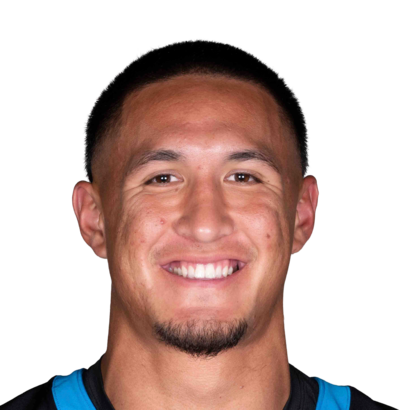
Fantasy Football Bust Candidates For 2026: A Sophomore Slump Incoming For Tetairoa McMillan
Adam Pfeifer profiles five players who could be in store for significant regression in 2026 and fail to live up to their fantasy football ADPs.
We don’t dislike players.
We dislike fantasy football ADP.
That’s really what it comes down to when breaking down fantasy football bust candidates. Identifying players who may not live up to their draft position, especially with similarly projected players coming off the board a few picks later. It’s not fun to be a pessimist, but here are my top bust candidates for the 2026 season.

Join Our Newsletter
Trusted by 400,000+ fantasy football players. Get access to Fantasy Life's free award winning newsletter and tools, all in one step.
By registering or logging in, you agree to our Terms of Use and Privacy Policy.
Bust Candidates For 2026 Fantasy Football
 Matthew Stafford | QB | LAR
Drafted outside the top-15 quarterbacks, the 38-year-old Stafford not only finished as fantasy’s QB4 on a PPG basis (21.1), but also took home the NFL MVP award. And yet, here I am, telling you to avoid drafting him in 2026.
Makes sense.
“Regression” can be tossed around rather loosely at times, but Stafford truly can’t escape it. His 7.7% TD rate was easily the highest of his career (6.8% was his previous high), and over 2% higher than his 5.6% as a member of the Rams. The Rams did a great job of deploying 13 personnel at the goal line to get opposing defenses in heavier, run-stopping looks, only to throw quick slants or fades to Davante Adams. Stafford had seven goal-line passes from 13 personnel last year, scoring six touchdowns. And overall, his 13 goal-line pass attempts tied with Drake Maye for the league lead, while his 54 end-zone pass attempts ranked second.
A dip in touchdowns and passing volume can be stomached if a quarterback makes up for it with rushing production. Unfortunately, Stafford’s rushing can make you want to throw up. Since 2021, Stafford has averaged 1.69 rush attempts and 2.1 rushing yards per game, while scoring just one rushing touchdown during that stretch. Of course, Stafford is still playing at an elite level and has a terrific supporting cast to help him continue to post terrific numbers. But I’d expect QB2 fantasy production this year, rather than the top-three numbers.
 Omarion Hampton | RB | LAC
Admittedly, this one absolutely terrifies me. Yes, Hampton’s breakout rookie season was derailed by an ankle injury. But before then, we saw the flashes of elite fantasy upside. From Weeks 3-5 (post Najee Harris injury), Hampton’s per-game averages:
- 14.3 carries
- 6.0 targets
- 5.7 receptions
- 20 touches
- 121.4 scrimmage yards
- 21.8 PPR
Entering the 2026 season, Hampton will be the lead option for the Chargers’ new rushing attack under Mike McDaniel, the league's best run-game designer. But will it feature multiple players? During Hampton’s absence, Kimani Vidal filled in admirably, ranking 13th in rushing yards and 14th in YAC/ATT (3.1). Los Angeles also signed Keaton Mitchell, who McDaniel coveted, giving them the game-breaking speed that perfectly complements this run scheme.
Look. There are more positives than negatives for Hampton’s fantasy prospects in year two. A healthy offensive line and an elite, fantasy-friendly scheme are now in town. But I do think given McDaniel’s track record, it is still possible we see multiple running backs used. And at the end of the day, Hampton’s ADP (RB8, 14.6 overall) is a tad high for me. Give me Chase Brown, Kenneth Walker and Derrick Henry.
 Bucky Irving | RB | TB
Having a running back that can rip off explosive runs is awesome. They can change the game on just one single carry.
But solely relying on those runs for fantasy football is less exciting.
That could very well be the case for Bucky Irving in 2026. Shoulder and foot injuries sidelined Irving for seven games last season. And when he did return, the usage wasn’t exactly what we're looking for from a fantasy running back. Sure, he averaged a strong 18.8 touches per game from Week 13 on, but it didn’t translate to stellar fantasy production. Irving was dominating the carries in between the 20s, but wasn’t seeing the high-value touches we covet in fantasy.
He was suddenly a trap back.
From Weeks 13-18, Irving handled 65% of Tampa Bay’s rushing attempts (good), but averaged 11.1 PPR points per game (not so good). That ranked outside the top-25 running backs during that stretch. Per the Fantasy Life Utilization Report, Irving logged just 13% of the long-down-and-distance snaps after returning from injury, while 41% of the two-minute snaps went to Rachaad White. Irving averaged just 1.8 receptions and 14 receiving yards per game, but perhaps most importantly, he saw zero carries from inside the five-yard line all year long.
Sean Tucker became this team’s short-yardage option, accounting for 88% of the inside-the-five carries. And with Kenneth Gainwell set to take the Rachaad White role (and then some), Irving could still lead this team in carries, but the absence of high-value touches will lead to some empty stat lines for fantasy.
 Tetairoa McMillan | WR | CAR
Look. McMillan is an awesome player coming off a very impressive rookie year. And as crazy as it is to say about a 23-year-old sophomore wide receiver, I actually question the fantasy ceiling.
70 catches, 1,014 yards and 7 touchdowns is a very strong season, especially for a rookie. But it didn’t exactly translate to a ton of fantasy upside on a weekly basis. McMillan finished as WR16 overall and WR20 PPG. He finished as a top-12 wideout just twice all year long, while ranking outside the top-24 receivers in 12 of 17 weeks. Of course, to no one’s surprise, McMillan operated as the clear alpha in Carolina, sporting a 26% target share, while his 43% air yards share ranked fifth among all wideouts with at least 100 routes. Entering 2026, McMillan will once again lead this team in targets, while his 56% catch rate should improve.
But can this overall passing attack improve?
The Panthers aren’t going to air the ball out very much. Last year, Carolina ranked 27th in pass rate over expected (-4%), while their 66% pass rate when trailing by four-plus points ranked 22nd. And while he’d occasionally show flashes, Young failed to reach 200—not even 300—passing yards in 12 of 17 games. And among 37 qualified quarterbacks, Young’s metrics didn’t exactly wow anyone:
- 30th in EPA/play (-0.03)
- 33rd in YPA (6.3)
- 22nd in CMP% (63.6%)
Again, no one should expect McMillan to struggle for targets in this offense. But it is also fair to wonder what the target share might look like with a fully healthy Jalen Coker, who made his season debut in Week 8. And following Carolina’s Week 14 bye, which included Carolina’s playoff game against the Rams, the usage was eyebrow-raising:
- McMillan: 23% target share, 18% TPRR, 25% EZ targets
- Coker: 22% target share, 19% TPRR, 32% EZ targets
On draft day, I’d prefer Jaylen Waddle, Garrett Wilson and Terry McLaurin over McMillan, all of whom are being drafted after him.
 Jake Ferguson | TE | DAL
Ferguson finished as fantasy’s TE10 last year, averaging just over 11 points per game.
I don’t care.
He saw 102 targets (7th among tight ends), but his volume was inflated by games CeeDee Lamb either missed or left early. In five games, Lamb played fewer than 50% of snaps (or missed entirely), Ferguson averaged eight targets and 17 fantasy points per contest. Two of his three highest-scoring outings came with Lamb sidelined. Just take a look at his utilization from Weeks 3-6 in particular:
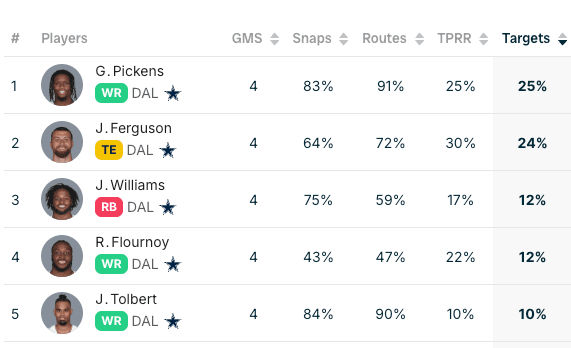
Meanwhile, when Lamb and George Pickens played in full, Ferguson averaged just 5.6 targets, 4.3 catches, 32.6 receiving yards and 9.5 PPR PPG. A dip in targets is especially notable for Ferguson since he doesn’t make the most of his looks to begin with. Ferguson recorded just two plays of 20-plus yards last year, while sporting an aDOT of just 5.0 yards. In this offense, Ferguson will give you a solid weekly floor of receptions. But if Lamb and Pickens are healthy, there isn’t a very enticing ceiling.
Join Our Newsletter
Trusted by 400,000+ fantasy football players. Get access to Fantasy Life's free award winning newsletter and tools, all in one step.
By registering or logging in, you agree to our Terms of Use and Privacy Policy.
Players Mentioned in this Article

Published Updated